Sep 7, 2006

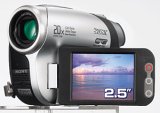
Sony DCR-DVD653E

DVD Camcorder .: Made for televideography and telephotography with ease.

Features:
Carl Zeiss Vario-Tessar Lens and 1/6”CCD
The world’s most famous lens for its excellent quality, high resolution, high contrast and outstanding colour reproduction while capturing true-to-life images 20xOptical/800x Digital Zoom. Closer to your subject, without missing a single detail.

DVD+RW-RW/-R Recording Formats On a 2 sided disc, you can record up to 60 minutes in SP mode and up to 120 minutes in LP mode. Include recording on a DVD-R*, which can only can be written once, or on a DVD+RW**/-RW*, which can be written repeatedly. With DVD+RW**, you can playback your movies instantly on a wide variety of DVD Players. For instant access to any scene, use Visual Index. Enjoy the slide show of your still images on your TV screen, by activate the Photo

Movie function
2.5” Hybrid LCD with Touch Panel & Visual Index
The user-friendly camera features with a simple touch on the generous 2.5” LCD screen. Want a quick look at a certain scene? Gain instant access via the Visual Index function.
*DVD-R/RW media recorded in video mode can played back on Sony DVD players/recorders sold after the year 2000
** Certain models of DVD players/recorders and PC’s (with DVD-ROM drives) may not be able to playback DVD+RW disc. * 1/6” CCD
(NTSC: Gross: 680K pixels, Effective: 340K pixels)
(PAL: Gross: 800K pixels, Effective: 400K pixels)
* CZ Vario-Tessar (Filter Diameter: 30 mm)
* Zoom (20x Optical, 800x Digital)
* 123 K CVF
* 2.5” Hybrid LCD Monitor (123K)
* Touch panel function w/ Active Menu
* P Battery type, STAMINA 5 hrs
* Picture Package supplied PC software
* Intelligent Accessories Shoe (New)
* DVD-R / -RW / +RW compatible recording
* Auto Lens Cover
Review and links ...

More review about Mp3 Player, Digital Camera and Digital Camcoder Please visit this link :
mp3 player
Digital Camcoder Review
Digital Camera Review

More Digital Camcorder Review :
sony-dcr-dvd653e
ddv-1000
panasonic-vdr-d150
sony-dcr-hc46
panasonic-vdr-d300
sony-dcr-dvd-803e
canon-dc20
how-to-shoot-good-digital-video-with
digital-video-camera-rental-putting
video-camcorder-sites-reviews-prices
sony-hdr-hc3-hdv-1080i
sony-dcr-dvd301
sony-vct-mtk-tripod
archos-gmini-402-camcorder-20-gb
jvc-gr-dv3000u-digital-camcorder

Sep 5, 2006

One-Time-Use Video Camcorder

By Kyle Monson
Rent or buy? That's the question these days for everything from real estate to music and DVDs. And with the price of even mediocre digital camcorders still too high for most folks, it was only a matter of time until a more affordable solution appeared.

CVS is the first to reach the market, with the One-Time-Use Video Camcorder ($30 street): You buy it from your local CVS drugstore, shoot your video, and return it to the store for processing to DVD (a $13 fee), after which CVS repackages it and sells it again. Think of it as renting with no late fees, or a disposable camera that CVS doesn't actually dispose of when you're done with it.

We took a look at the solution as a whole—the camcorder, DVD interface, and video output—to see how it stacked up against your typical digital camcorder. There were some pluses, such as the clean user interface, and some minuses, like the video quality and the limited (20 minutes) amount of footage you can shoot.


The main consideration here is price. We didn't expect to see the best video quality from an inexpensive reusable camcorder, and indeed we didn't. Of course, between the initial cost and the processing fee, you're paying more than $40 for 20 minutes of video clips. If you use the service more than a few times, you'd be better off saving up for a camcorder that's yours to keep. Then again, you can think of the unit as an auxiliary to your current camcorder and use it in places you wouldn't want to take a $1,000 piece of electronic equipment, like the beach or a campground.

CVS says that though they reuse the camcorders, they consider them purchased, not rented, so there's no fee if it comes back damaged (or doesn't come back at all).
The camcorder itself, made by Pure Digital Technologies, looks good, and the shooting experience is akin to that of the Sony DCR-DVD7—you hold the camcorder in front of you and use the LCD screen as a viewfinder. Though there aren't any extras like a light or zoom, the 1.4-inch screen is adequate, and the four buttons on the back—on/off, record, playback, and delete—keep things simple. The LCD image rotates when you turn the camera sideways or upside down. Curiously, the video you shoot doesn't rotate along with the LCD, so you can be fooled into shooting a bunch of upside-down footage. There's no tripod mount, though the square-ish camcorder is able to stand on its own.

You can play back your 20 minutes of video with sound and delete anything you don't want to keep. When the camcorder is full, return it to CVS for processing, which takes roughly 30 minutes. You don't get the camcorder back, but you do get a remarkably full-featured DVD with your footage. The video, which is encoded in MPEG-4 during shooting, is burned onto the DVD in MPEG-1, WMV, and VOB file formats, giving users plenty of options. You can play the video back on a regular DVD player or in Windows Media Player, or use the MPEG-1 version to edit the video footage using video-editing software. The included video-editing tool launches automatically in both Macs and PCs, and runs directly from the DVD, so there's no software to install.

The video-editing tool's user interface is as simple and intuitive as the controls on the camcorder itself, which is perfect for first-time videographers. Actually, it's much more streamlined than most interfaces we've seen for full-fledged video-editing software, which are often overly complex. Options, features, and a help index are all on the main page, so you won't have to go digging for the functions you want.

The video-editing tool breaks footage up into scenes automatically; every time you push Record on the camcorder, it starts a new scene. The Make Movie button threads selected (or all) chapters together into a continuous movie, and the Save for Editing button saves the MPEG-1 footage to your hard drive. You can easily add captions to the video clips, and we especially appreciated the playback timeline that let us easily navigate through the video clips.
Our favorite feature, however, was the Save for Emailing function, which lets you upload WMV video to the CVS Online Video Gallery Web site, which e-mails a link to your friends and family for viewing. (You specify who you want the video to go to before uploading it.) When recipients click on the link, it takes them to a Web page with the video and gives them the option to stream the content or download it. The video is saved online for 30 days. A similar process is used for sending video greeting cards.

So there are plenty of ways to use the video, but what of the video itself? Our PC Labs test results were about what we expected them to be. The color saturation was low, making for very dull reds and oranges, and yellows with a slight blue/green cast. Resolution was about half that of a normal camcorder—250 vertical lines of resolution and 200 horizontal lines.
The camcorder adjusted fairly quickly to changes in light, so there were very few blown-out whites. We saw lots of shimmering and stairstepping, though, especially when we walked outside and shot some real-world footage in the sunlight.

Naturally, the camcorder doesn't have image stabilization, so you're likely to experience motion sickness if you spend as much time watching the playback as we did. We also noticed a bit of jerkiness in the video, which looked like it was due to low frame rates. Pure Digital assured us that the camcorder shoots at 30 frames per second, but the footage still looked slightly hyperactive and the motion wasn't very smooth. Video quality was noticeably worse when we played the video on a television screen, with muddy colors and lots of artifacts. Audio quality was a bit tinny and muddled, but passable.
So the question remains: Rent or buy? If you're only going to be using the service a couple of times, the CVS One-Time-Use Camcorder is a good alternative to dropping a wad of cash on a camcorder you'll seldom use. Otherwise, look to a value-priced camcorder like the JVC GR-D33US for much better video quality and hardware you can keep.
Sep 4, 2006

Review: Sony DCR-SR100 30GB

By Terry Sullivan
Hard drive camcorders have taken on the buzz that high-definition TV had last year, especially among early adopters. Until recently, though, only JVC had hard drive camcorders on the market. When CES 2006 rolled around, however, Sony introduced its own, the steeply priced DCR-SR100 30GB Handycam ($999.99 list), and instantly heated up the space. And although the DCR-SR100 has its share of issues, it's the best hard drive camcorder I've seen to date.
The DCR-SR100 has a 10X optical zoom lens and decent digital stabilization. The device has a very respectable 3-megapixel sensor for taking still images. It's also got a very nice 2.7-inch–wide, articulating, touch-screen LCD. Other features include a built-in flash and an intelligent shoe on top for adding accessories such as the recently introduced ECM-HW1 Bluetooth wireless microphone.

* Digital Camcorder Guide : canon gl2 digital camcorder, canon gl2, gl2, underwater camcorder housing, camcorders, camcorder tapes, canon camcorders, high definition camcorders, rca camcorder batteries, 3ccd camcorder, dvd camcorder, dcr trv480, dcr dvd403

Like the JVC hard drive camcorders, the DCR-SR100 also has a drop-detection sensor system, meant to protect the hard drive from shocks and sudden, jarring movement. Unlike JVC's camcorders, however, the DCR-SR100 doesn't turn off when that sensor is activated, a seemingly safer way to protect the hard drive. I did notice that the drop sensor appeared each time I tested this camcorder in different near-drop scenarios.
The DCR-SR100 is pretty big for a camcorder. At 3.4 by 2.8 by 5.9 inches, it's about 1.5 inches longer than the JVC GZ-MG77U. At 1.3 pounds, it's also about 6 ounces heavier than the 0.9-pound GZ-MG77U. That may not seem like much, but a few ounces can mean a lot if you are carrying the device for a long time.

* Digital Camcorder Guide : canon gl2 digital camcorder, canon gl2, gl2, underwater camcorder housing, camcorders, camcorder tapes, canon camcorders, high definition camcorders, rca camcorder batteries, 3ccd camcorder, dvd camcorder, dcr trv480, dcr dvd403

In my PC Magazine Labs tests, I found that the DCR-SR100 had somewhat better image quality than the GZ-JG77U. In my talking-head clip, I found the video to be well exposed, with good contrast and color. Sound was slightly better than that of the GZ-MG77U. Color was very accurate and vibrant without being oversaturated. The camcorder also performed well in low light, producing little noise and few artifacts. Overall, the image was clear and sharp.
In the action clip, the DCR-SR100 did a much better job than the GZ-MG77U did in quickly locking into autofocus. There was a bit of artifacting, especially on the signs we use in our tests. On the EIA resolution chart, the DCR-SR100 scored a decent 425 average lines of resolution, although miniDV camcorders have scored better. When set to its highest-quality mode, the DCR-SR100 can shoot 440 minutes of video. I found it quite easy to import the .MPG files into the Adobe Premiere Elements 2.0 program for editing.

* Digital Camcorder Guide : canon gl2 digital camcorder, canon gl2, gl2, underwater camcorder housing, camcorders, camcorder tapes, canon camcorders, high definition camcorders, rca camcorder batteries, 3ccd camcorder, dvd camcorder, dcr trv480, dcr dvd403

The camera lets you shoot 3MP still photos, which is good enough for a nice 4-by-6 print. The 10X optical zoom lens has a 35mm equivalent of a 37- to 370mm zoom range. Despite the passable size of the pictures and the nice zoom range, however, performance is slow, and there was significant shutter lag as well as slow recycle times. But the GZ-MG77U offers still images of just 2MP, which is even lower quality.

The DCR-SR100's daylight image had little noise, but the flash test shot displayed more colored noise. Both test shots had decent colors that were fairly accurate and vibrant. I saw very little fringing, but both shots were soft throughout the image. Overall, the exposure of both the flash and the daylight images was decent. I found the flash coverage to be quite good.
I was surprised to find the camcorder scored 1,050 lines on our resolution test, which is very good for a 3MP camera. The boot-up took a little over 4 seconds, which is decent for a camcorder, but the 4.4-second recycle time was pretty slow. The most significant problem was the significant shutter lag, a common problem in hard drive camcorders.

I had wondered if the DCR-SR100, the first hard drive camcorder from Sony, would be good enough to be awarded an EC. Its high price and relative bulkiness held it back from that nod, but it's still the best hard drive camcorder I've tested.

--------------------------------------------------------------------------
canon gl2 digital camcorder, canon gl2, gl2, underwater camcorder housing, camcorders, camcorder tapes, canon camcorders, high definition camcorders, rca camcorder batteries, 3ccd camcorder, dvd camcorder, dcr trv480, dcr dvd403, cctv digital video recorder, digital camera and video, high speed digital video, security digital video recorder, digital video security, digital video cables, digital video projector, digital video system, 4 channel digital video recorder, digital video recording, digital video systems, portable digital video recorder, digital video tape, digital video recorder dvr, digital video recorder, digital video camera recorder, digital video cable, high definition digital video recorder, digital video surveillance system, digital video recorders, digital video production, personal digital video recorder

Sep 3, 2006

Review: HDR-HC3 HDV 1080i

By Terry Sullivan
I once read an art history book about the public's reaction to Leonardo Da Vinci's mural The Last Supper. Painted in 1495, the image had such a realistic sense of space and intensity of detail that after viewing it, no one wanted to "settle" for the status quo anymore. Da Vinci had raised the bar for rendering realistic images. I was reminded of this when I first studied, on an HDTV monitor, the hi-def video footage I captured with the Sony HDR-HC3 HDV 1080i Handycam camcorder ($1,499.95 direct). The quality of the video blew standard definition footage out of the water. Simply put, the HC3 sets a new standard in the consumer camcorder arena.

I'm not saying the camera itself is a masterpiece. But overall, Sony has improved on its first HD consumer camcorder, the HDR-HC1 HDV 1080i Handycam Camcorder, by making the HC3 more portable and more affordable (by $500).

When you pick up this miniDV camcorder, you'll be surprised that it's nearly the size of some of the higher-end DVD camcorders, such as Sony's DVD505. Even so, at 3.3 by 3.1 by 5.5 inches and 19 ounces (with tape and battery), the camera is easy to hold and carry around.

* Digital Camcorder Guide
* Listen to Terry talk about the Sony HDR-HC3 HDV Handycam on Gearlog Radio (MP3)
* Sony HDR-HC1 HDV 1080i Handycam Camcorder
* Sony Cyber-shot DSC N1
* Sony DCR-DVD505

Like the HC1, the HC3 features a 10X optical zoom and a widescreen 2.7-inch touch-sensitive LCD. What Sony dropped on this camcorder is the manual focus ring found on the HC1. In its place, they've added an effective Cam Control Dial and a manual button near the front of the camera, just in front of where the LCD swivels out. You can change the settings (in the menus) so that you can control not only the focus with this little dial, but elements such as exposure and white balance. Still, I prefer the more precise control I got with the focus ring.

In both real-world and lab tests, the HC3's video footage, when viewed on either an HDTV or a computer monitor, offered exceptionally clear details and the subtlest of textures. I loved how in the footage of my kids playing around and jumping in a pool on a bright, sunny summer day, the camcorder accurately rendered all the vibrant colors on my daughter's bathing suit, the thinnest strands of my son's spiky hair, and the tiniest droplets of water splashing up after a dive. It also produced stunning results when I pointed the camera at the sky, where the sun had just been covered by a dark cloud. An extreme lighting situation such as this can often produce badly exposed video, but the HC3 caught it all. I was quite impressed with both the speed and quality of Sony's auto exposure.

The HC3 also adjusted well in low-light scenarios. When I stood in a dim interior and pointed the camcorder at both it and a bright exterior (moving back and forth between the two environments), the HC3 kept pace by quickly adjusting both the exposure and the focus. The ensuing indoor footage was a tad grainy, but the details were all clear and sharp, which surprised me, since there is only one sensor in the camera. (Three-sensor cameras are generally better at capturing low-light settings.)

The HC3 stores video footage on a miniDV tape in 1080i (when set to its highest quality setting), which films at roughly 60 interlaced fields per second, or about 30 frames per second. (See a demonstration of how camcorders capture video differently). You can set the camera to record at standard-definition video, but I suggest always using the highest HDV quality setting and then "downconverting" when burning a standard-definition DVD.

The HC3 comes equipped with many of the usual Sony features, and they performed well. For example, the Nightshot mode performed admirably, letting me capture smooth, nonstreaky video, although it is nearly monochrome, like all night-shot modes. I also had fun using the Smooth Slow Record mode that was introduced on the DVD505, which lets you film in real time and play back the footage in slow motion (without sound).

In my lab tests, I found the camera had an impressive 700 average lines of resolution—although this is not quite as high as the HC1's 750 lines of resolution. Still, it clearly surpassed the 300-to-400 range of other camcorders. The bootup time was less impressive, as it took more than 8 seconds to start.

In my still-camera tests, the HC3 had mediocre performance and displayed significant shutter lag, which is not unusual for a camcorder. The HC3 can capture 4-megapixel still images, but I wasn't impressed with their quality. The Canon DC40 DVD camcorder, which also captures 4MP stills, did a better job in both my flash and daylight test shots, and its images were sharper and had more vibrant color that those of the HC3. That's mainly because the CMOS sensor on the HC3 captures only 2.1MP worth of data and then interpolates it up to a 4MP image.

Also, I found that Sony didn't do much to remedy some of the gripes I had with the HC1. For starters, it didn't include any software in the box, which is peculiar, as Sony's Vegas 6 video editor lets you capture and edit high-definition files. Why not include a "lite" version of Vegas 6? Sony also didn't change the menu structure. I think it would do well to emulate the successful menus it has built into the Cyber-shot DSC N1 digital still camera.

Although the HC3 represents a big jump for those in the consumer camcorder market, it's not what I would consider a prosumer or professional camcorder, even for someone who might want to shoot a wedding or a special event. My main concern is that the camera has limited external controls, such as a manual focus ring. And because there is no external mic jack on the HC3, there's no way to improve your audio quality by adding an external microphone. That's crucial. (I should note that the HC3 did, in my tests, work with Sony's ECM-HW1, the recently introduced Bluetooth wireless microphone that fits into the camcorder's intelligent shoe. But again, this is targeted at consumers—the mic is not a professional-quality device). So for college students or filmmakers on limited budget, the HC1 might be a better buy.

Despite these minor gripes, I think the Sony HDR-HC3 HDV 1080i Handycam, like its predecessor, the HC1, stands alone as our Editors' Choice for a HD consumer camcorder. Simply put, its incredible video quality has no equal.
-----------------------------------------------------------------------------------------------------------------------
More article about camcorder, camera and mp3 players. Tips, review or information can be found here at ( don't forget to make donation klik for these site also) :
http://mp3-player-new-trend-gadget.blogspot.com
http://best-new-digital-video-camcorder-info.blogspot.com
http://new-best-camera-digital-review-cheap.blogspot.com

Sep 2, 2006

Pure Digital Point - Shoot Video Camcorder

By Terry Sullivan
As everybody knows that minimalism has applied to the camcorder design, not only just in size but almost in every way. the designers of the Pure Digital Point & Shoot Video camcorder scaled down and reworked the elements that go into a camcorder. They borrowed some of what went into the CVS One-Time Use Video Camcorder, but added a few key features. It is hard to rave about a camcorder that has no optical zoom, but as it sells for less than $130, it is hard to criticize the Point & Shoot.

Powered by two double-A batteries, this white and silver camcorder holds up to 30 minutes of 30-frames-per-second, VGA-quality video in its 512MB of built-in flash memory. It uses MPEG-4 encoding to ensure small file sizes. Removable flash media has been very successful with digital cameras, where it's been the mainstay for a decade. There have also been some camcorders that store video on SD cards, such as the Panasonic SDR-S100 SD Camcorder, although their quality was limited until quite recently, because the cards have been so small. Whether built-in flash memory will become more popular is anyone's guess, but it does help keep prices down.
By Terry Sullivan

It seems that minimalism has come to the world of camcorder design. And I don't mean just in size. In almost every way, the designers of the Pure Digital Point & Shoot Video camcorder scaled down and reworked the elements that go into a camcorder. They borrowed some of what went into the CVS One-Time Use Video Camcorder, but added a few key features. It is hard to rave about a camcorder that has no optical zoom, but as it sells for less than $130, it is hard to criticize the Point & Shoot.

Powered by two double-A batteries, this white and silver camcorder holds up to 30 minutes of 30-frames-per-second, VGA-quality video in its 512MB of built-in flash memory. It uses MPEG-4 encoding to ensure small file sizes. Removable flash media has been very successful with digital cameras, where it's been the mainstay for a decade. There have also been some camcorders that store video on SD cards, such as the Panasonic SDR-S100 SD Camcorder, although their quality was limited until quite recently, because the cards have been so small. Whether built-in flash memory will become more popular is anyone's guess, but it does help keep prices down.

* Digital Camcorders Guide
* CVS One-Time-Use Video Camcorder
* Panasonic SDR-S100 SD Camcorder

The camcorder measures approximately 2.3 by 4 by 1 inches and is very light. On the front you'll see only the lens and the onboard microphone. On the back there's a tiny 1.5-inch LCD, a white on/off button, a play button, and a delete button. Centered under the LCD screen is a red record button, surrounded by a four-way controller. On one side, you'll find a TV-out port and a USB connector, which pops out when you push down a sliding button just under the place where the connector is housed.

And that's it. All for $129.99 list.

What I like most about the Point & Shoot Digital is that it is easy to use. Just press the red button to start and stop recording. Delete what you don't want. Play back what you want to review. What could be simpler? It would have helped to get some more functionality on the camcorder—a pause button, perhaps, or a fast-forward or rewind. But the company's emphasis on simplicity and sparseness is admirable. Although I'd have appreciated more technical specifications while writing this review, I like that the manual is very basic.

One caveat: I suggest you stay away from using the 2X digital zoom. That just degrades the quality of the video, and you're not starting with outstanding footage quality to begin with. The company has tried to make it easy for you to play your videos on either a computer or TV. On a computer, connect the camcorder via USB and click on the file called View your videos.exe. This runs a program that lets you watch, delete, or e-mail your videos. To play video on your TV, simply connect the included A/V cable from the camcorder to your TV's or VCR's A/V terminals. Then press Play to view it.

In my real-world testing, I filmed a still life near a window with bright light and deep shadows. As I suspected, I found the camera couldn't film both the still life and the detailed objects outside. The dynamic range isn't wide enough to capture both the details outside in the sunlight and the objects in shadows. But overall, I was impressed by the color saturation, most of the midrange details, and the lack of distortion in the scene.

In my lab tests, the "Talking Head" clip revealed good, strong exposure. There were some noticeable aberrations. For instance, the PC Magazine logo had a moiré pattern in my video. The camcorder also had difficulties in low light and couldn't accurately capture details in the shadowed areas. The audio was somewhat muffled.

I was happy with the autofocus. Colors, however, are a bit too vibrant and saturated. And the EIA Resolution Chart revealed an average of 325 lines of resolution, well below that of other camcorders I've tested. The boot-up time for this little camcorder is pretty slow, at 6 seconds.

The Point & Shoot Digital stored the video clips as AVI files—and they opened up easily in Windows Media Player 9.0. The clips were also easy to import into Adobe Premiere Elements 2.0.

As a portable camcorder, the Pure Digital Point & Shoot Video camcorder does a great job of providing you with decent video clips with serviceable audio, all at a very cheap price. We'll have to stay tuned to see if any of the big camcorder companies try to produce a Point & Shoot of their own.
The camcorder measures approximately 2.3 by 4 by 1 inches and is very light. On the front you'll see only the lens and the onboard microphone. On the back there's a tiny 1.5-inch LCD, a white on/off button, a play button, and a delete button. Centered under the LCD screen is a red record button, surrounded by a four-way controller. On one side, you'll find a TV-out port and a USB connector, which pops out when you push down a sliding button just under the place where the connector is housed.

And that's it. All for $129.99 list.

What I like most about the Point & Shoot Digital is that it is easy to use. Just press the red button to start and stop recording. Delete what you don't want. Play back what you want to review. What could be simpler? It would have helped to get some more functionality on the camcorder—a pause button, perhaps, or a fast-forward or rewind. But the company's emphasis on simplicity and sparseness is admirable. Although I'd have appreciated more technical specifications while writing this review, I like that the manual is very basic.

One caveat: I suggest you stay away from using the 2X digital zoom. That just degrades the quality of the video, and you're not starting with outstanding footage quality to begin with. The company has tried to make it easy for you to play your videos on either a computer or TV. On a computer, connect the camcorder via USB and click on the file called View your videos.exe. This runs a program that lets you watch, delete, or e-mail your videos. To play video on your TV, simply connect the included A/V cable from the camcorder to your TV's or VCR's A/V terminals. Then press Play to view it.

In my real-world testing, I filmed a still life near a window with bright light and deep shadows. As I suspected, I found the camera couldn't film both the still life and the detailed objects outside. The dynamic range isn't wide enough to capture both the details outside in the sunlight and the objects in shadows. But overall, I was impressed by the color saturation, most of the midrange details, and the lack of distortion in the scene.

In my lab tests, the "Talking Head" clip revealed good, strong exposure. There were some noticeable aberrations. For instance, the PC Magazine logo had a moiré pattern in my video. The camcorder also had difficulties in low light and couldn't accurately capture details in the shadowed areas. The audio was somewhat muffled.

I was happy with the autofocus. Colors, however, are a bit too vibrant and saturated. And the EIA Resolution Chart revealed an average of 325 lines of resolution, well below that of other camcorders I've tested. The boot-up time for this little camcorder is pretty slow, at 6 seconds.

The Point & Shoot Digital stored the video clips as AVI files—and they opened up easily in Windows Media Player 9.0. The clips were also easy to import into Adobe Premiere Elements 2.0.

As a portable camcorder, the Pure Digital Point & Shoot Video camcorder does a great job of providing you with decent video clips with serviceable audio, all at a very cheap price. We'll have to stay tuned to see if any of the big camcorder companies try to produce a Point & Shoot of their own.
-------------------------------------------------------------------------------------------
More article about camcorder, camera and mp3 players. Tips, review or information can be found here at ( don't forget to make donation klik for these site also) :
http://mp3-player-new-trend-gadget.blogspot.com
http://best-new-digital-video-camcorder-info.blogspot.com
http://new-best-camera-digital-review-cheap.blogspot.com